
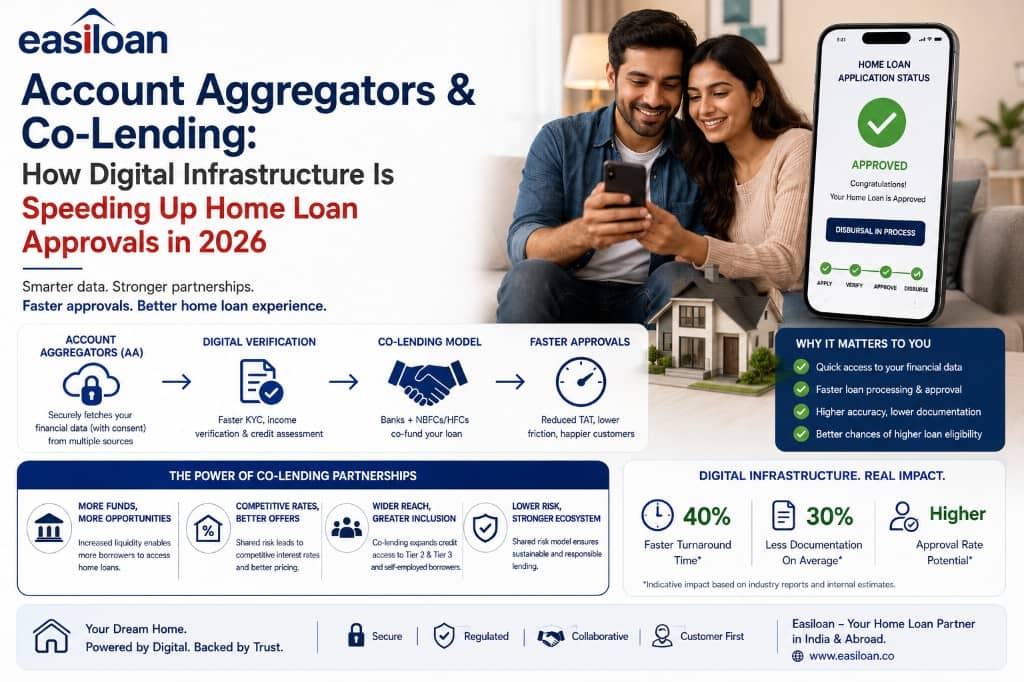
If your last home loan application involved photocopying bank statements and waiting days for a verification call, it’s worth knowing that the plumbing behind loan approvals has changed significantly — and home loans are now one of the fastest-growing categories benefiting from it.
The Account Aggregator framework, explained simply
The Account Aggregator (AA) system is a consent-based data-sharing framework, licensed and regulated by the RBI, that lets you securely share your own financial data — bank statements, tax filings, and more — directly from the source institution to a lender, with your explicit digital consent, instead of manually uploading scanned documents. You approve exactly what’s shared and for how long, through an AA app, and the data moves in encrypted form directly between institutions.
For a lender, this replaces a slow, error-prone, and sometimes fraud-prone process (fabricated or edited bank statements have long been a headache for underwriting) with structured, verified data arriving in minutes rather than days.
Why this matters specifically for home loans right now
According to data from Sahamati, the RBI-recognised self-regulatory body for the AA ecosystem, India’s Account Aggregator framework facilitated an estimated ₹3.82 lakh crore in loan disbursals across 3.68 crore loans in FY26, now accounting for roughly 8.4% of India’s retail and MSME lending by value. The standout number for homebuyers: AA-enabled home loans and loans against property touched 1.09 lakh loans worth ₹20,777 crore in FY26 — a 624% year-on-year increase. That’s not incremental growth; it’s a signal that home loan underwriting is moving toward this model faster than almost any other loan category, as banks increasingly integrate AA connectivity directly into their loan origination systems.
Notably, banks accounted for 47.3% of AA-enabled lending by value in the second half of FY26, nearly matching non-bank finance companies — meaning this isn’t just a fintech-NBFC phenomenon, mainstream banks are adopting it at scale for secured lending too.
What co-lending adds to the picture
Alongside AA, the RBI’s co-lending framework — where banks and NBFCs jointly originate and fund a loan, sharing risk and typically offering the borrower a blended interest rate — has scaled considerably in recent years. For a borrower, a co-lending arrangement can mean access to a bank’s lower cost of funds combined with an NBFC’s wider reach and faster processing, particularly useful for self-employed borrowers or those in smaller towns where bank branch density is thinner.
What this means for you as a borrower
- Faster underwriting for standard salaried profiles. If your income and banking data is clean and consistently reflects your stated income, AA-based verification can meaningfully cut the time between application and sanction compared to manual document review.
- Fewer requests for physical document resubmission. Since data comes directly and securely from the source, lenders are less likely to flag discrepancies that trigger repeated document requests.
- A real advantage for thin-file or self-employed borrowers. AA-based cash-flow analysis lets lenders assess actual banking behaviour over months, rather than relying solely on a credit bureau score — useful if your credit history is limited but your cash flows are healthy.
- You control what’s shared. Unlike handing over physical statements, AA consent is granular and time-bound — you can see exactly what data was requested and for how long access was granted.
What to actually do differently when applying
- Ask your lender whether they support AA-based document verification — where offered, it’s typically faster and reduces manual back-and-forth.
- Keep your primary salary or business account active and consistent, since AA-based underwriting leans heavily on visible, verifiable cash flow patterns.
- If you’re a self-employed applicant who has struggled with traditional documentation requirements in the past, specifically ask lenders about cash-flow-based underwriting — this is exactly the segment AA adoption is designed to help.
- Don’t assume every lender has adopted this yet — AA integration varies significantly by institution, so it’s still worth comparing processing timelines across lenders rather than assuming uniform speed.
The bottom line
The shift toward Account Aggregator-based verification and bank-NBFC co-lending isn’t a distant fintech trend — it’s already processing tens of thousands of crores in home loans every year, and growing fast. If speed and documentation friction have been a pain point in your home-buying process before, it’s worth asking your shortlisted lenders directly how much of their home loan process is now digital-first. Compare lenders and check your eligibility on Easiloan to see which offers get you to a sanction letter the fastest.
Check eligibility
Compare live home loan offers from multiple banks and NBFCs, and check your eligibility in minutes.
Check eligibilityBy Easiloan · Easiloan Techno Solutions Pvt. Ltd. · Terms and conditions apply. Credit at sole discretion of lender, subject to credit appraisal, eligibility check, rates, charges and terms.