
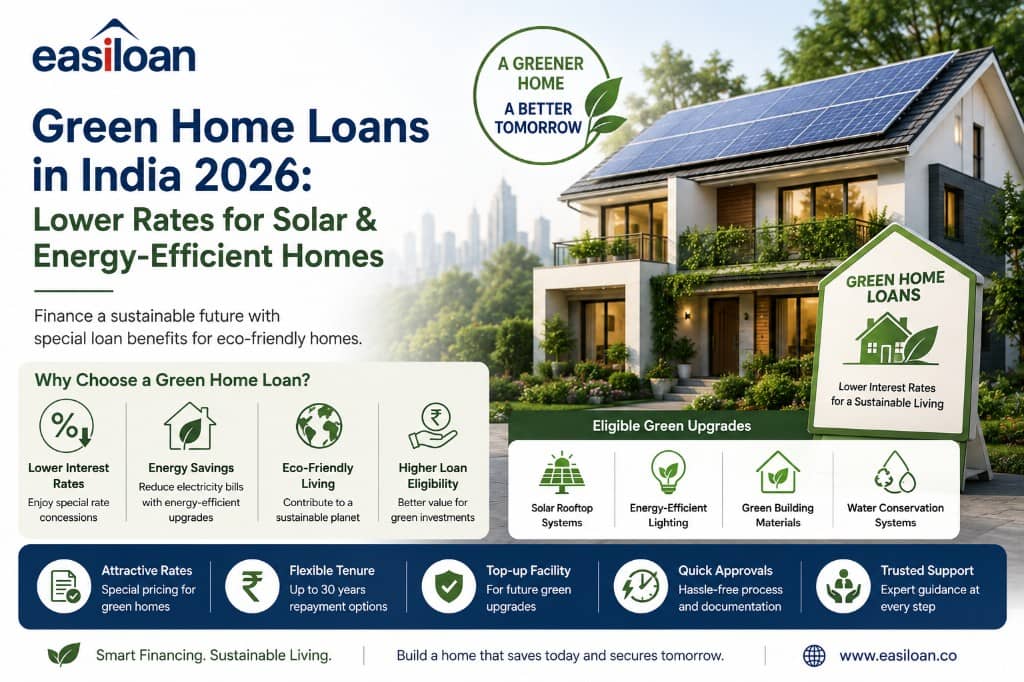
India now ranks among the top countries globally for green-certified buildings, and lenders have noticed. A small but growing number of banks are offering “green home loans” — home financing with a modest rate concession for buyers of certified energy-efficient or eco-friendly properties, or for homeowners adding solar and other sustainable upgrades.
What qualifies as a “green home” for lenders
Most banks tie their green home loan eligibility to third-party certification, most commonly:
- IGBC (Indian Green Building Council)
- LEED (Leadership in Energy and Environmental Design)
- GRIHA (Green Rating for Integrated Habitat Assessment)
A property carrying one of these certifications typically incorporates features like better insulation, water-efficient fixtures, renewable energy integration, and energy-efficient appliances — the underlying reason lenders view these loans as marginally lower-risk over the long run, since utility-cost savings for the homeowner can support easier repayment capacity.
What the rate concession actually looks like
The discount isn’t dramatic, but it’s real: most banks offering green home loans price them roughly 0.10% to 0.50% below their standard home loan rate. For context, State Bank of India has offered green home loan pricing in the roughly 7.25%–8.95% band with a small concession built in, HDFC Bank has extended green loan pricing benchmarked to its Retail Prime Lending Rate with rates starting from around 7.75%, and Bank of Baroda has offered a concession of around 10 basis points on its standard ROI for green-certified properties, subject to a floor rate.
On a large loan over a long tenure, even a 0.25% saving compounds into a meaningful amount — but it’s rarely, by itself, a reason to choose one lender over another; it’s more of a tie-breaker when other terms are comparable.
Solar loans: the more accessible green financing option
If your existing home isn’t certified green but you want to add rooftop solar, most major banks now offer dedicated solar loan or solar top-up products, separate from the certified-green-home category:
- SBI’s solar loan schemes (including its Surya Ghar rooftop solar financing) have priced from around 8.5% for well-qualified applicants, for loans up to ₹30 lakh with tenures up to 15 years.
- HDFC offers solar financing as a top-up on an existing home loan, typically processed faster for existing customers since KYC is already on file, with rates generally in the 9.00%–10.50% range.
- IREDA (Indian Renewable Energy Development Agency) offers specialised residential solar financing, typically in the 8.75%–9.5% band.
For many homeowners, a solar top-up loan is the more practical entry point into green financing — it doesn’t require your entire property to carry a green building certification, and the EMI on a modest rooftop system is often comparable to the electricity bill it replaces.
Tax angle to know about
Separate from the interest-rate concession, home loan interest paid on a loan for an energy-efficient property meeting specified standards can, in some structures, qualify for an additional deduction of up to ₹1.5 lakh — though this is conditional on the property meeting defined energy-efficiency criteria, so it’s worth confirming applicability with a tax advisor rather than assuming it applies automatically.
Is a green home loan worth actively pursuing?
It makes the most sense if you’re already planning to buy a certified green property or add solar for its own sake — the utility savings and long-term value are the primary draw, and the rate concession is a bonus on top. It’s generally not worth stretching your property search purely to chase a green certification for a 0.25% rate saving, when a well-negotiated standard home loan from a competitive lender could offer a comparable or better all-in rate.
The bottom line
Green home loans and solar financing are still a relatively small slice of the Indian home loan market, but the number of lenders offering them is growing, and the rate concessions — while modest — are genuine. If sustainability features are already part of your home-buying criteria, ask your shortlisted lenders directly whether they offer a green home loan variant, and compare it against their standard product before assuming it’s automatically the better deal.
Check eligibility
Compare live home loan offers from multiple banks and NBFCs, and check your eligibility in minutes.
Check eligibilityBy Easiloan · Easiloan Techno Solutions Pvt. Ltd. · Terms and conditions apply. Credit at sole discretion of lender, subject to credit appraisal, eligibility check, rates, charges and terms.