
Looking to apply soon? Compare lenders after checking your loan amount eligibility to make a confident choice.
Building your own home is one of life's most fulfilling milestones — but turning that vision into bricks and mortar demands significant capital at every stage. A home construction loan is specifically designed to fund this journey, disbursed progressively as your house takes shape, so you only borrow — and pay interest on — what you actually need, when you need it.
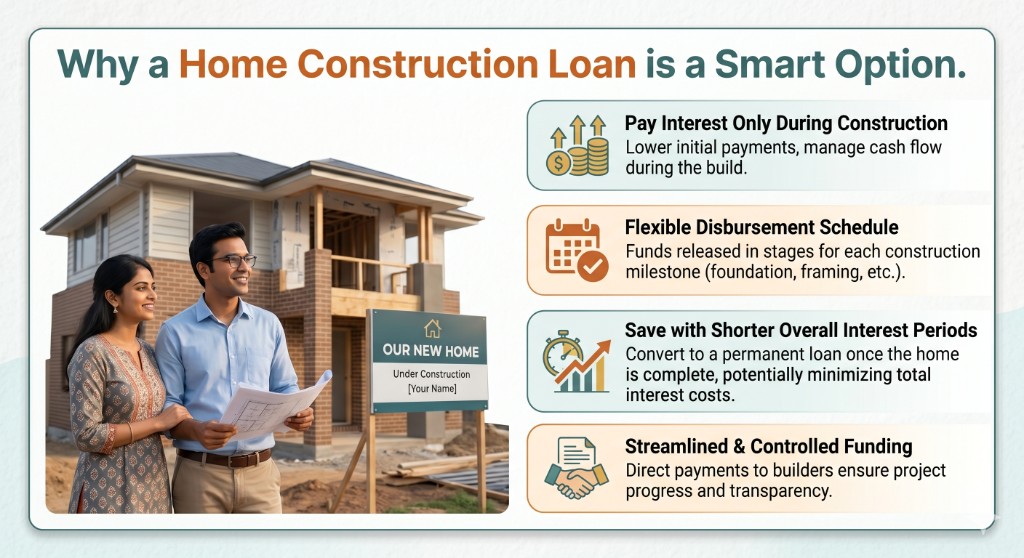
What Is a Home Construction Loan?
A home construction loan is a short-to-medium term secured financing product that covers the end-to-end costs of building a house on a plot you already own. Unlike a standard home loan — where a lump sum is disbursed upfront to purchase a ready or under-construction property — a construction loan is released in tranches tied to verified stages of construction.
The loan covers a wide range of expenses, including:
- Architectural plan drafting and structural design fees
- Municipal permits, building approvals, and NOC charges
- Raw materials — cement, steel, bricks, sand, tiles, wiring
- Labour and contractor payments at each construction phase
- Interior finishing — flooring, plumbing, electrical fittings
- Emergency cost overruns flagged by your contractor during construction
Key difference from a regular home loan: A standard home loan disburses the full amount to a seller or builder. A construction loan disburses in stages based on the actual progress of construction — verified by a lender-appointed technical inspector. This protects both you and the lender.
Types of Home Construction Loans
Before applying, it's important to understand which category of construction finance suits your situation:
Construction-Only Loan
A short-term loan (typically 12–18 months) that covers only the construction period. At completion, it must be repaid in full or converted to a regular home loan.
Construction-to-Permanent Loan
Automatically converts to a long-term home loan upon construction completion. Avoids the need for two separate loan applications and closings.
Home Renovation / Extension Loan
For existing homeowners looking to add a floor, extend a room, or renovate. Typically based on property value after improvement.
Owner-Builder Construction Loan
Designed for self-managing construction without a formal contractor. Rare and harder to get — lenders require proof of expertise or a licensed supervisor.
How Loan Disbursement Works: Stage by Stage
Unlike a standard home loan, construction loan funds are released progressively. A lender-appointed technical team inspects the site before authorising each tranche. This is one of the most distinctive features of this loan type:
Stage 1 — Foundation & Plinth
First tranche released after commencement of construction and completion of the plinth level. Covers excavation, foundation, and base slab costs.
≈ 15–20% of loanStage 2 — Column & Beam Framework (RCC)
Released upon completion of the structural column and beam casting — the skeleton of the house.
≈ 20–25% of loanStage 3 — Brick Masonry & Roof Slab
Tranche released after brick walls are raised and roof slab is cast on all floors.
≈ 20–25% of loanStage 4 — Plastering, Flooring & Fittings
Released after internal plastering, flooring, doors, windows, and basic electrical and plumbing work are done.
≈ 20–25% of loanStage 5 — Final Completion
Last tranche released upon Completion Certificate or Occupancy Certificate from the local authority.
≈ 10–15% of loanHow to Apply Without Hassle: 5 Smart Steps
Maintain a Healthy Credit Score
A CIBIL score above 750 significantly improves your chances of sanction and gives you bargaining power on interest rates. Check your score 3–6 months before applying and clear any outstanding dues or disputes. A score below 650 can lead to rejection or a higher rate of interest.
Calculate Your Eligibility and EMI Upfront
Lenders determine your eligibility based on income, repayment capacity, existing obligations, and the estimated construction cost. Use EasiLoan's Construction Budget Planner below to estimate the loan amount you may qualify for before approaching any lender.
Prepare Your Construction Documents
Beyond standard KYC and income documents, construction loans require a detailed set of property and project papers: approved building plan from the municipal authority, architect's cost estimate, structural drawings, NOC from the local body, and plot ownership documents. Use the checklist below to stay organised.
Hire Reputed, Licensed Contractors and Architects
Lenders want confidence that the project will be completed on time and within budget. You will need to furnish your contractor's registration credentials, insurance certificates, proof of past project completions, and a clear breakdown of each party's responsibilities. Unregistered or informal contractors may lead to outright rejection.
Budget for Cost Overruns
Construction costs are rarely fixed. Material prices — sand, steel, cement — can fluctuate, and unforeseen site conditions can add expense. Lenders expect you to demonstrate personal reserves of 10–20% above the sanctioned loan. This also protects you from project stalls if the lender doesn't cover overruns.
Construction Budget Planner
Estimate your construction cost and eligible loan amount before approaching a lender.
Benefits of a Home Construction Loan
Interest Only During Construction
You pay interest only on the amount disbursed so far — not on the full sanctioned amount. This reduces your financial burden during the construction phase when your cash flow is already stretched.
Flexible Loan Terms
Construction loans offer greater flexibility compared to standard home loans — you can adjust the disbursement schedule based on actual construction progress, and some lenders allow tenure extensions if the project faces delays.
Built-in Project Oversight
Stage-wise inspection by the lender's technical team means any construction defects or deviations are flagged early — providing an additional layer of quality assurance beyond what your contractor offers.
Build Exactly What You Want
Unlike buying a flat or builder property, construction on your own land gives full control over design, layout, and materials. A construction loan funds that freedom without depleting your savings.
Tax Benefits Available
Once construction is complete and possession taken, you can claim interest deductions under Section 24(b) up to ₹2 lakh per year, and principal repayment under Section 80C up to ₹1.5 lakh — same as a regular home loan.
Asset Appreciation
A self-constructed home on your own plot typically appreciates faster than a flat in a large housing society. The combined value of land + construction can be a strong long-term investment.
Eligibility Criteria at a Glance
| Parameter | Typical Requirement |
|---|---|
| Age | 21–65 years (loan must close before 70–75) |
| Employment Type | Salaried or self-employed / business owner |
| CIBIL Score | 700+ preferred; 750+ for best rates |
| Land Ownership | Plot must be owned and registered in applicant's name |
| Plot Location | Municipal / panchayat-approved; rural plots accepted by select lenders |
| LTV Ratio | Up to 75–80% of estimated construction cost |
| Construction Timeline | Must be completed within 2–3 years of disbursement (varies by lender) |
| Approved Building Plan | Mandatory — from the local municipal authority |
How to Choose the Right Lender
Not all construction loans are the same. Here is what to evaluate when shortlisting a lender:
Check if the lender offers construction loans in your city or town — including rural and semi-urban locations where approval rates can vary.
Understand whether the rate is fixed, floating (linked to repo rate), or a hybrid. Floating rates are currently more common and may benefit you as RBI rates ease.
Check if the lender auto-converts to a long-term home loan post-completion, saving you re-application costs and potential rate hikes.
Delays in tranche release can stall construction. Ask about the average time from inspection request to disbursement.
Compare processing fees (0.5–2%), technical inspection fees, legal charges, and prepayment penalties across lenders.
If your plot is in a tier-3 city, town, or village, verify if the lender specifically offers construction finance for non-metro locations.
Documents Required for a Home Construction Loan
Personal & Financial Documents
- Aadhaar Card, PAN Card (both applicants if joint)
- Last 3 months' salary slips or 2 years' ITR (self-employed)
- 6 months' bank statements (salary/current account)
- Form 16 / CA-certified P&L and Balance Sheet
- Passport-size photographs
Property & Construction Documents
- Original plot sale deed and registered title documents
- Encumbrance Certificate (EC) for the last 13–30 years
- Municipal-approved building plan and layout
- Architect's cost estimate with item-wise breakup
- Structural engineer's drawing and certificate
- NOC from the local gram panchayat / municipal body
- Contractor agreement with timeline and payment schedule
Construction Loan Checklist
0 of 8 items ready
Pro tip: Keep all construction-related bills, receipts, and material purchase records organised in a folder. Lenders may ask for these during technical inspections to validate expenses before releasing the next tranche.
Frequently Asked Questions
Can I get a construction loan if I don't own a plot yet?
Most home construction loans require you to already own the plot. However, some lenders offer a composite loan — a combined plot purchase + construction loan — where both the land acquisition and building costs are financed together. The loan is disbursed in two phases: the first tranche covers the plot purchase, and subsequent tranches are released as construction progresses.
What happens if my construction costs exceed the sanctioned loan?
Construction overruns are common. If costs exceed the sanctioned amount, you will need to fund the difference from personal savings. Some lenders allow a top-up loan after re-assessment of the project cost and your repayment capacity. This is why lenders strongly recommend maintaining a buffer of at least 10–20% above your estimated cost.
Is the interest paid during construction tax-deductible?
The interest paid during the pre-construction (construction) period is eligible for deduction under Section 24(b), but it is accumulated and claimed in five equal annual instalments starting from the financial year in which construction is completed. The standard annual ceiling of ₹2 lakh applies for self-occupied properties.
What if construction is delayed beyond the stipulated timeline?
Most lenders allow a 12–18 month buffer beyond the agreed construction period. If delays are significant, you must communicate proactively with your lender and provide a revised completion timeline. Extended delays can result in the lender converting the loan to a standard term loan prematurely, increasing EMI obligations.
Can I change my construction plan after the loan is sanctioned?
Major changes to the approved building plan (additional floors, changed layout) require you to get a revised plan approved by the municipal authority and inform your lender. Lenders may need to reassess the revised cost estimate before releasing further tranches. Minor internal changes generally don't require lender approval.
Can I prepay or foreclose a home construction loan early?
Yes. Once the construction is complete and the loan has been converted to a regular home loan, you can make partial prepayments or foreclose the loan. As per RBI guidelines, floating rate loans from banks carry no prepayment penalty for individuals. Fixed-rate loans and NBFC loans may have a prepayment charge of 2–4% of the outstanding amount.
Build Your Home. Let EasiLoan Fund It.
From foundation to finishing — EasiLoan connects you with construction finance that matches your timeline and budget.
Check Loan Eligibility →Free eligibility check. No spam. No hidden charges.
Related Articles
Compare construction loan offers in minutes
Check your eligibility and see offers from top banks. No impact on your credit score for the initial check.
Check eligibility