
Every quarter, the National Housing Bank quietly publishes one of the most useful data sets a homebuyer never checks: the NHB Residex, India’s official house price index, tracking primary market property values across 50 cities. It doesn’t get the headlines that an RBI rate decision does, but if you’re deciding where and when to buy, it tells you more about your actual affordability than the repo rate alone.
What the latest data shows
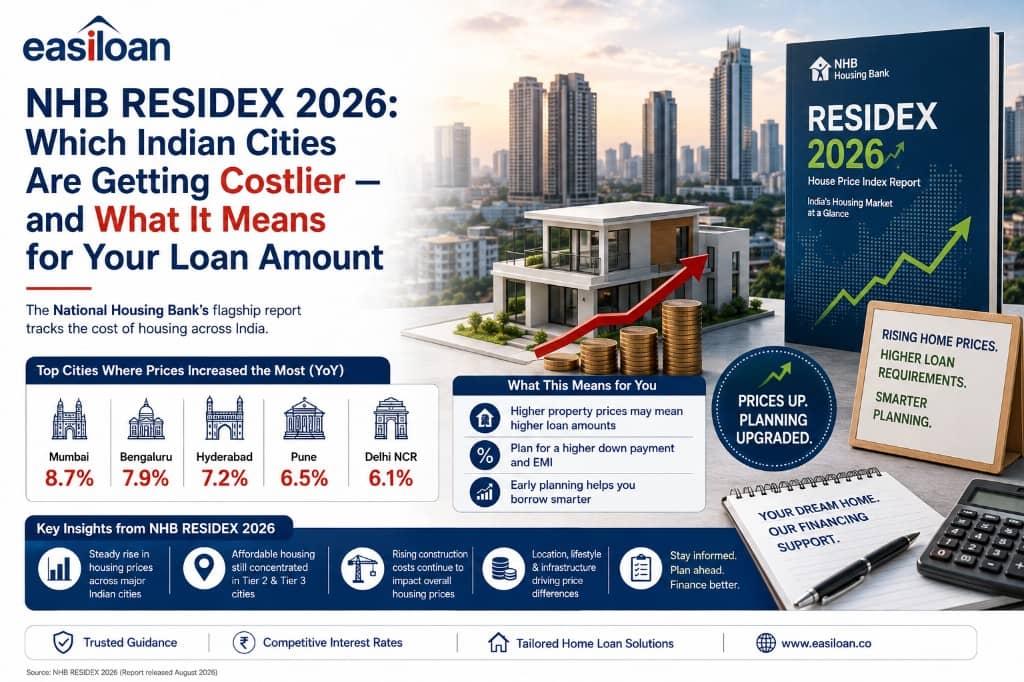
According to NHB Residex figures for Q3 FY26 (the October–December 2025 quarter), most tracked cities recorded annual price increases, with several markets posting particularly sharp gains: Bengaluru led with 12.7% annual growth, followed by Chennai at 8.2%, Ahmedabad at 6.8%, and Kolkata at 6.7%. Mumbai and Pune saw comparatively moderate annual growth of 3.7% and 3.5% respectively, while Hyderabad recorded a more modest 3.2% increase. This built on an earlier quarter (Q1 FY26) in which 45 of the 50 tracked cities posted annual gains, with a national average increase of 5.7% — a pace slightly cooler than the 6.6% recorded a year earlier, but still a clear, broad-based upward trend.
Not every city moved in the same direction. In earlier readings, a handful of markets — including Kochi, Thiruvananthapuram, and Howrah — registered annual declines, a reminder that “the Indian housing market” isn’t one market, but dozens of local ones moving on their own supply-demand dynamics.
Why this matters more than it might seem
- Your loan eligibility is tied to the property’s assessed value, which lenders benchmark against prevailing market rates — in a city where prices are rising fast, your bank’s valuation might already price in some of that momentum, affecting how much you can borrow at a given LTV.
- Rising prices in high-growth cities like Bengaluru mean your down payment requirement grows in absolute terms even if the LTV percentage stays the same — a 25% down payment on a property that’s appreciated 12.7% in a year is a meaningfully bigger cheque than the year before.
- Slower-growth or declining markets can be a window for value buyers, but it’s worth understanding why a city is flat or falling — genuine oversupply and weak demand are a different story from a temporary post-completion lull.
- City-level divergence is a reason to avoid extrapolating national headlines to your specific market — a national average of 5–6% growth tells you little about what’s actually happening in your target locality.
What drives the divergence between cities
Broadly, cities posting the sharpest gains tend to combine strong end-user demand with infrastructure momentum — metro expansions, IT and business-hub growth, and improving connectivity all show up in the data with a lag. Cities seeing softer or negative growth are often working through a temporary oversupply in specific micro-markets, or facing slower job growth relative to their housing pipeline.
How to actually use this data before you buy
- Check the city-specific NHB Residex trend for your target market (available on NHB’s Residex portal) rather than relying on national averages.
- If you’re buying in a fast-appreciating city, get your loan pre-approved early — property valuations and your required down payment can shift meaningfully over a few months of searching.
- If you’re buying in a flatter or declining market, use the slower pace to negotiate on price rather than assuming you need to move quickly.
- Cross-reference Residex trends with local factors — upcoming infrastructure (metro lines, expressways), inventory overhang, and local employment trends — rather than treating the index as the only signal.
The bottom line
The NHB Residex is one of the few genuinely independent, standardised measures of how Indian housing prices are actually moving, city by city — and in 2026, the story is one of broad-based but uneven growth, with Bengaluru, Chennai, and Ahmedabad running well ahead of the pack. Before you finalise a property, check where your city sits on this curve, and use Easiloan to get your loan eligibility and pre-approval sorted so you can move quickly if you’re buying in a market that’s heating up.
Check eligibility
Compare live home loan offers from multiple banks and NBFCs, and check your eligibility in minutes.
Check eligibilityBy Easiloan · Easiloan Techno Solutions Pvt. Ltd. · Terms and conditions apply. Credit at sole discretion of lender, subject to credit appraisal, eligibility check, rates, charges and terms.