
Most homebuyers know that a bigger down payment lowers their EMI. Fewer know there’s a regulatory reason a smaller loan-to-value (LTV) ratio can also get you a cheaper interest rate — and it comes down to a technical RBI rule called risk weighting that most borrowers never see, but every bank pricing team thinks about.
What a risk weight actually is
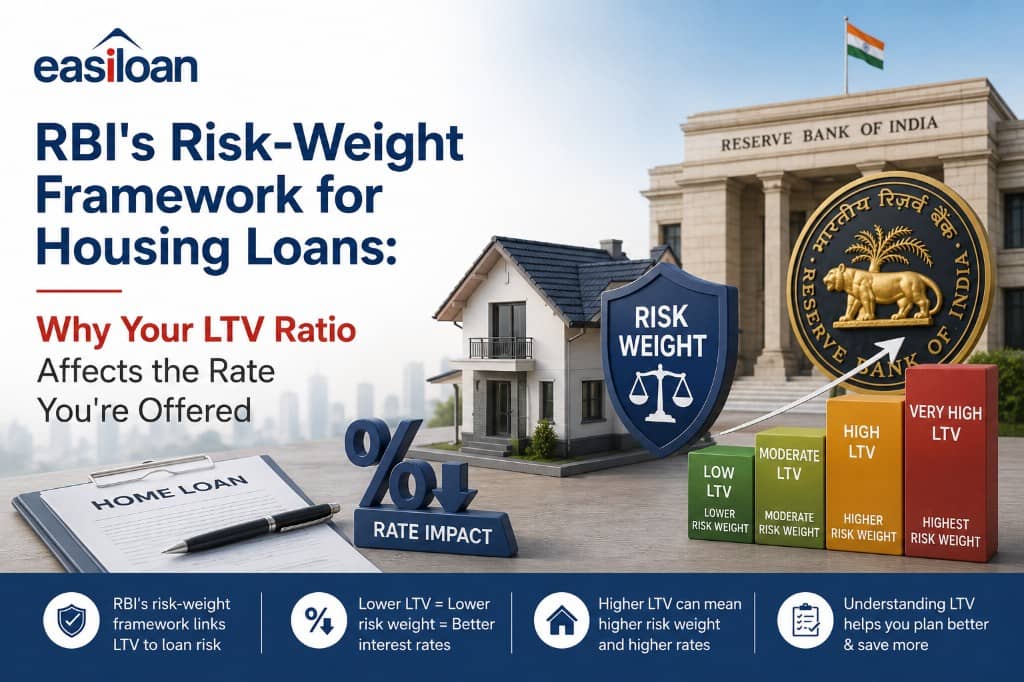
When a bank sanctions a housing loan, it has to set aside a slice of its own capital against the possibility that the loan goes bad. The RBI decides how much capital by assigning a “risk weight” to each loan — a lower risk weight means less capital has to be locked up, which makes that loan cheaper for the bank to carry on its books. The RBI ties these risk weights on individual housing loans to the loan’s LTV ratio: the lower your LTV (meaning the more you’re putting down upfront), the lower the risk weight, and the less capital the bank needs to hold against your loan.
How LTV bands currently work
Under RBI’s LTV framework, home loans are grouped into value bands, each with its own maximum LTV cap:
- Loans up to ₹30 lakh: maximum LTV of 90%, meaning you can put down as little as 10%.
- ₹30 lakh to ₹75 lakh: LTV caps typically around 80%.
- Above ₹75 lakh: LTV generally capped at 75%, requiring a 25% down payment.
Within each band, a loan with a lower LTV (bigger down payment relative to the cap) usually attracts a lower risk weight than one sanctioned right at the ceiling — and low gross NPA ratios on housing loans (around 1% industry-wide) have supported RBI’s case for keeping these risk weights relatively benign compared to other retail credit categories.
Why this quietly affects the rate you’re quoted
Banks don’t publish “your risk weight is X, so your rate is Y” — but the capital cost logic flows through to pricing indirectly. A loan that’s cheaper for the bank to hold (lower risk weight) contributes less to the bank’s overall capital requirement, and lenders often reflect that in the spread they add over their benchmark rate for lower-LTV applicants. This is one of several reasons why two borrowers with identical credit scores can be quoted slightly different rates once you account for how much they’re putting down.
The prepayment rule that changed alongside this
Separately, but relevant to the same regulatory push toward borrower-friendly housing credit, RBI’s Pre-payment Charges on Loans Directions, 2025 removed prepayment and foreclosure charges on floating-rate loans taken by individuals for non-business purposes, for all loans sanctioned or renewed from January 1, 2026 — with no lock-in period before you can prepay, regardless of whether there’s a co-borrower on the loan. Fixed-rate loans can still carry a prepayment fee, but it must be disclosed upfront in the sanction letter and Key Facts Statement, and can’t be introduced or increased later.
What this means practically when you’re shopping for a loan
- A larger down payment isn’t just about a smaller loan amount — it can also nudge you into a more favourable risk-weight (and therefore pricing) band.
- Ask each lender for their rate at different LTV levels rather than assuming the headline rate applies regardless of how much you put down.
- If your loan is floating-rate and was sanctioned or renewed after January 1, 2026, confirm in writing that no prepayment penalty applies — this is now your regulatory right, not a negotiable perk.
- Compare LTV-linked pricing across lenders, since not every bank passes the capital saving through to the borrower in the same way.
The bottom line
RBI’s LTV-linked risk-weight framework is one of the quieter levers behind why home loan pricing isn’t one-size-fits-all. If you can stretch your down payment even a little beyond the minimum, it’s worth asking your lender whether that moves you into a better pricing band. Compare real, LTV-adjusted offers from multiple lenders on Easiloan before you finalise your loan amount.
Check eligibility
Compare live home loan offers from multiple banks and NBFCs, and check your eligibility in minutes.
Check eligibilityBy Easiloan · Easiloan Techno Solutions Pvt. Ltd. · Terms and conditions apply. Credit at sole discretion of lender, subject to credit appraisal, eligibility check, rates, charges and terms.