
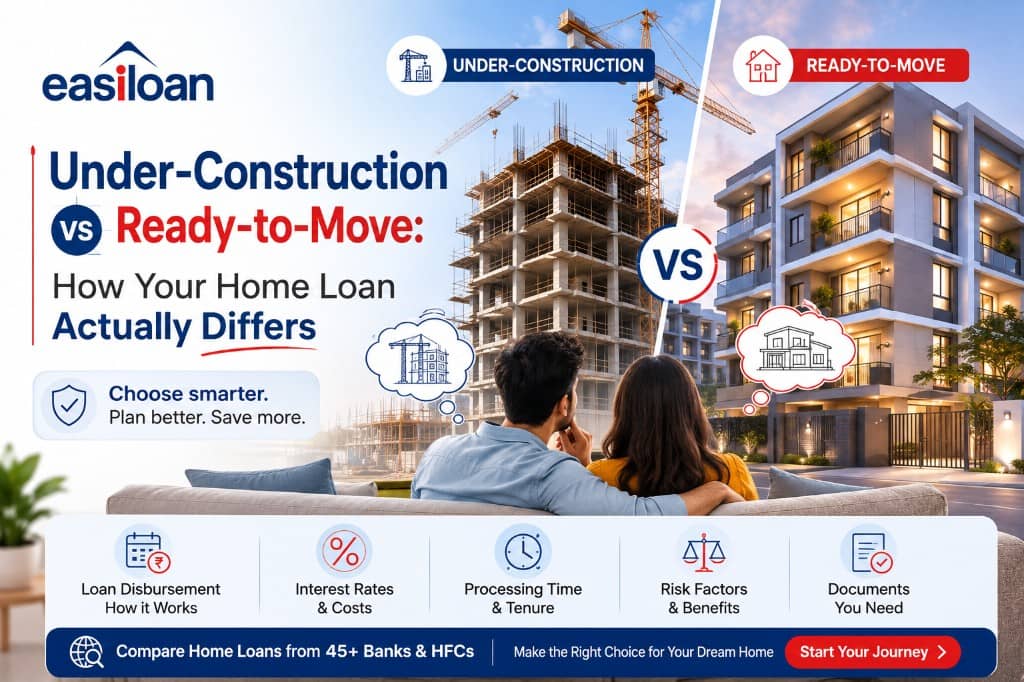
The property type you choose changes how your loan is disbursed, when EMIs start, and even your tax benefits. Here's the full comparison.
The choice between an under-construction property and a ready-to-move-in home isn't just about waiting time — it changes how your loan is disbursed, when your EMIs actually start, and how your tax benefits work.
01How Disbursement Differs
Ready-to-move-in: The lender disburses the full sanctioned loan amount in one go at registration, and your standard EMI begins immediately.
Under-construction: The lender disburses in stages, linked to construction milestones set by the builder and verified by the bank's technical team. Until the property is fully disbursed, most lenders charge you either simple interest on the amount disbursed so far (a "pre-EMI") or, if you opt for it, a full EMI on the entire sanctioned amount from day one.
Lump Sum
Ready-to-Move Disbursement
Staged
Under-Construction Disbursement
Pre-EMI or Full EMI
Your Choice, Under-Construction
02Pre-EMI vs Full EMI: The Real Trade-Off
- Pre-EMI means you pay interest only on the disbursed amount during construction — lower monthly outflow, but you don't reduce the principal until full disbursement and EMI kick in, meaning a longer effective repayment period.
- Full EMI from day one means higher payments during construction, but you start reducing principal immediately and finish repayment sooner — useful if you can afford the higher outflow while also paying rent elsewhere.
03Tax Treatment Differs Meaningfully
This is where many buyers get caught out. Under Section 24(b), you cannot claim the interest deduction on an under-construction property until you take possession. Interest paid during the construction period ("pre-construction interest") isn't lost — it can be claimed in five equal instalments starting the year you get possession, but it's deferred, not immediate.
For a ready-to-move-in property, the interest deduction (up to ₹2 lakh) is available from the very first year of the loan, since possession is immediate.
04Risk Considerations
Under-construction: Carries builder and project delivery risk — delays extend your pre-EMI period and push your possession-linked tax benefit further out. RERA registration is a critical check here.
Ready-to-move-in: You can physically inspect the property and typically pay no GST on a completed unit, but the price per square foot is often higher than an equivalent under-construction unit.
Rent + pre-EMI overlap: If you're renting while your under-construction home is being built, budget for both simultaneously — this is one of the most commonly underestimated costs of buying under-construction.
05Which Should You Choose?
If immediate tax benefit, price certainty, and no delivery risk matter most, ready-to-move-in is the lower-risk choice. If budget stretch, potential price appreciation during construction, and a longer investment horizon are more important, under-construction can work — provided the project is RERA-registered and the builder has a credible delivery track record.
Check Your Eligible Rate
Compare personalised home loan offers across lenders in minutes — no impact on your credit score.
Check My Rate →Quick Facts
- Ready-to-Move GSTNil (on completed property)
- Under-Construction GSTTypically applicable
- DisbursementLump sum (ready) vs staged (under-construction)
- Interest Deduction (Pre-Possession)Claimable in 5 equal instalments after possession
Related Reading
Frequently Asked Questions
Can I claim home loan interest deduction on an under-construction property?▾
Not until you take possession. Interest paid during construction (pre-construction interest) can be claimed in five equal instalments starting from the year of possession, within the overall ₹2 lakh Section 24(b) limit.
What is a pre-EMI and how is it different from a regular EMI?▾
A pre-EMI is interest-only payment on the amount disbursed so far during construction. A regular EMI includes both principal and interest and reduces your outstanding loan balance.
Is GST applicable on a ready-to-move-in property?▾
Generally no, GST is not applicable on a completed, ready-to-move-in property with an occupancy certificate. Under-construction properties typically attract GST, which adds to the total cost.
Is it riskier to take a home loan for an under-construction property?▾
It carries additional project-completion risk compared to a ready property. Checking RERA registration, the builder's delivery track record, and project funding status helps reduce this risk before committing.
This article is for general information only and does not constitute financial or legal advice. Rates, fees, and government charges are indicative and change periodically — please verify current figures with your lender or the relevant government portal before making a decision.